Author: Hasan Shazil

  • Choosing the Right Print: Poster, Photo, or Fine Art?

    Choosing the Right Print: Poster, Photo, or Fine Art?

    Photography wall art is becoming more and more trendy these days. This is not surprising in times when we spend more time at home. Incorporating photography into your home decor will give your space a new aesthetic. Especially photo prints are a popular way to add artwork to your home. There are numerous types of paper on which you can print a photograph covering different levels of quality. However, with poster shops opening up all over the internet selling simple poster prints as “high quality photo prints” or even “fine art prints” it is easy for customers to get confused about what kind of product they are actually buying. Deciding whether it is worth its money can be difficult because of shops labeling their products something they are not. In this blog post I will therefore explain the differences between poster prints, photographic prints and fine art photography prints in the hope of making it easier for you to decide what type of print is right for you.

    Poster Print

    Many of us probably grew up with posters of our favorite band up on the wall. Poster prints are often mass produced for customers that want wall decor fast at the lowest price possible. They are printed on poster paper using regular inkjet printing technique. Weighing around 200 gsm (grams per square meter) or less the paper is thicker and more durable than regular paper. But because it doesn’t use archival inks and lacks protective coating, poster prints will fade and colors will lose their vibrance with time. Because of their short life span I don’t offer my photographs as poster prints.

    Photo Print

    A photo print or photographic print is printed on high quality professional photo paper. The paper used is thicker than the one used for poster prints. They come with different coatings such as gloss, matte, lustre or metallic which make them more resistant to light and therefore more long lasting than poster prints. Photographic prints are a great way to decorate your wall with high quality photo art at an affordable price.

    Fine Art Photography

    Fine art printing, as the name suggests, has become much of an art in recent years. Fine art photography prints are printed on premium quality acid free fine art papers using pigmented archival inks for outstanding results and extended longevity. With well over 300 gsm these papers are much thicker than normal photo paper. These prints are also known as fine art giclee prints. For the fine art prints offered on my website I use the Hahnemühle. This paper is made of 100% cotton and has a lifespan of over 100 years.

  • Hahnemühle Life Science

    Hahnemühle Life Science

    Hahnemühle strives to offer products and services that consistently meet our customers’ requirements and expectations by applying a strict quality management system. The DEKRA certification confirms that Hahnemühle meets all the requirements set out in DIN EN ISO 9001. The use of our quality management system guarantees a high standard of quality and a competitive position in international markets with increasingly stringent quality requirements.

    Moreover, the certification documents our intense customer focus, which covers every stage of the value chain from product development to service provision. Ongoing further product development and continuous process improvements allow us to exceed the required quality standards. Product manufacturers and quality assurance institutions must measure a product’s performance and quality in a wide range of applications to verify its suitability. ISO/EN standards, guidelines issued by shareholder associations and state agencies stipulate the processes and tools for each application, not to mention the thresholds that must be observed. Here you can find our Certificate of Conformity.

    Filter papers from Hahnemühle provide a high degree of security. Hahnemühle syringe filters and membranes are subject to stringent quality checks both during and after production. Finished products’ storage life in the warehouse is constantly monitored. Each filter holder also undergoes the following five tests: bubble point, burst pressure, membrane adsorption, flow rate and extractable substances.

    Hahnemühle has been a ‘Brand of the Century’ since 2016 and is part of the exclusive circle of Germany’s strongest brands.

    Sustainability 

    Clean water, natural fibres, first-rate expertise in paper production and absolute quality awareness have formed the foundation of our success for over 435 years. Using precious resources such as water, fibres and energy carefully and responsibly is a matter of course for us. The water we use to produce our valuable FineArt papers comes straight from the source and is set apart by its particularly high level of purity, meaning it requires no chemical treatment whatsoever. Even at the end of the production cycle, the wastewater has not been contaminated with pollutants and is returned to the river as high-quality water.

    As a paper manufacturer ISO 14001 & ISO 50001 certified for environmental, energy and resource management

    Hahnemühle is certified for all its sustainability measures and its environmentally sensitive actions according to the ISO 14001 guideline for environmental management and ISO 50001 for energy and resource management as well as EcoVadis certified. This is part of Hahnemühle’s journey to a carbon neutral future. 

  • Creating High Quality Mockups Of Your Artwork

    Creating High Quality Mockups Of Your Artwork

    This article focuses on covering different options for creating images of your digital artwork or photography for usage in various settings such as web and social media. We’ll walk you through 4 different options along with the pros and cons of each. We’ll also give you some useful tips and tricks on how to make the process as pain free as possible.

    If you are creating mockup images for usage on our artist selling platform (coming soon) its always best to size your images at around 822[w] x 528[h] pixels. We encourage people to use a mixture of close-ups and mockups to best showcase their work.

    Generally speaking there are 4 options that you can consider for creating beautiful mockups of your artwork. Below is a quick summary, after which we’ll talk about each one in a little more detail.

    OptionBenefitsDrawbacks
    *Recommended* Buy ready made mockup packs from EtsyVery inexpensive
    Really excellent qualityWide range of options
    You still have to pay to buy them
    Sizes of the frames may not be ideal for your needs
    You need some image editing skills, but really minimal
    Leverage online mockup toolsVery hassle free
    Low cost
    Can sometimes feel quite unnatural and lack authenticity
    Limited mockups available to choose from
    Create mockups in PhotoshopLow cost
    More control
    You either need to be good in Photoshop or pay someone else who is
    Still usually requires purchasing staged settings
    Print, frame and photograph works yourselfLooks more natural and authentic
    If you have the kit and knowledge, can be inexpensive
    You’ll need your work printed and framed
    Could become expensiveTime consuming
  • Epson Europe releases its 2023/24 Sustainability Report

    Epson Europe releases its 2023/24 Sustainability Report

    Epson, a global leader in technology has released its 2023/24 European Sustainability/ESG (Environmental, Social, and Governance) Report. It outlines the advances the company has made in the past year towards realising its 2050 goal of becoming carbon-negative and underground resource free. It also highlights how Epson is harnessing its technology to innovate practical, scalable solutions to address the most pressing environmental challenges the world faces.

    Key FY23 achievements include:

    • Business travel emissions reduced by 19%
    • Deliveries from factories in Asia optimised to reduce future CO 2emissions by an estimated 10-50% per container 1
    • Commitment to diversity, equity, and inclusion (DE&I) bolstered through implementing comprehensive manager training and company-wide e-learning initiatives
    • 100% plastic-free status achieved for all point-of-sale marketing materials

    “As a Japanese company, we have a profoundly deep-rooted respect for nature and sustainable practices,” explains Takanori Inaho, President at Epson Europe. “We have always been guided by the principle of Sho Sho Sei, which represents the commitment to continuous improvement behind the development of our world-leading compact, efficient, precise product technology.

    “Our latest ESG Report emphasises how we are applying this same, meticulous care and thought into how our proprietary technologies can be developed to contribute to practical, scalable climate solutions. We fully recognise our responsibility to mitigate the impact we have on the planet, and we’re deeply committed to finding ways for our pioneering technology to be used creatively to solve some of the most urgent environmental issues confronting the world.” 

    The report sets out Epson’s key achievements in executing its European ESG strategy, which is focused on four core pillars:

    Decarbonisation— In the past year, Epson has made tangible progress in advancing its decarbonisation goals. Business travel emissions have been reduced by 19% and customer deliveries from its Asian factories have been optimised, potentially cutting future CO 2emissions by 10-50% per container 1. The company has announced plans for construction of a biomass plant in Japan, which will harness energy from organic waste, thereby reducing its reliance on fossil fuels. In parallel, Epson has been developing carbon capture technology to mitigate its residual CO 2emissions.

    Advancing the frontiers of industry— Epson continues to develop its technology in groundbreaking ways to tackle wider societal sustainability challenges. Building on its Dry Fiber Technology (DFT), initially used for paper recycling, the company has partnered with the Hong Kong Research Institute of Textiles and Apparel (HKRITA), to extend DFT technology to separate tightly woven fabric fibres that cannot currently be separated for recycling. This expands DFTs role in addressing circular economy challenges.

    Epson also partnered with Japanese designer, Yuima Nakazato and Spiber Inc, the biotech company behind Brewed Protein TM, a synthetic protein fibre made through fermentation. Nakazato’s latest Paris Fashion Week collection utilised Epson advanced pigment inkjet printing on Brewed Protein, which is not possible with traditional analogue printing. This breakthrough expands creative possibilities for designers to adopt more sustainable fashion practices.

    Fulfilling our social responsibility— outside of its core business activity, Epson is deeply committed to operating ethically and responsibly within society. The company has reinforced its commitment to diversity, equity, and inclusion (DE&I), implementing comprehensive face-to-face manager DE&I training and a company-wide e-learning initiative. Epson’s Indonesian factories were once again awarded Responsible Business Alliance (RBA) Platinum status for ethical labour practices, environmental stewardship, and corporate social responsibility in its global supply chain.

    Strengthening its governance— Epson has received renewed certification from certified body, Bureau Veritas for the alignment of its business activities to the Sustainable Development Goals (SDGs). As a trailblazer in this field, Epson was the first technology company to receive certified recognition for integrating the SDGs into its operations.

    Boris Manev, Sustainability Director, Epson Europe B.V. further explains; “We have a clear vision: to pioneer sustainable innovation and set new standards in environmental responsibility. We believe that sustainability and business success are not mutually exclusive, and we’re demonstrating this through groundbreaking initiatives such as advancing textile recycling and collaborating with fashion industry leaders to innovate more sustainable solutions. Our investments in carbon capture and renewable energy, including the development of a new biomass plant, are key milestones on our journey towards a carbon-negative future. These initiatives reflect our deep commitment to protecting the planet for future generations.”

    Download the full report here: https://www.epson.co.uk/sustainability-report

    Notes to editor 

    The European Sustainability Report 2023/2024 details progress of the sustainability commitments and initiatives of Epson Europe for the financial year 2023 (FY23) period, (April 2023–March 2024) and was guided by the European directive relating to corporate sustainability reporting (Directive (EU) 2022/2464) and the Bureau Veritas sustainable development goals certification standard.

    1 Based on preliminary estimate using EcotransIT

  • Mounted Vs Matted Prints – Which Should You Order?

    Mounted Vs Matted Prints – Which Should You Order?

    Mounted vs Matted Prints

    More than the majority of you are probably reading the title on this blog post and don’t know what either of those options even are, let alone which option is better… The truth is, I don’t expect you to know any of it! That’s part of my job, to educate you on the best product for your need.

    Let’s be honest, to the eyes of most, a print is a print is a print. A piece of paper that has a photo on it and I can do things with it like frame it and it will last forever. Right? Not quite.

    Not all prints are created equally, and this blog post is going to help you know the differences between them, know when you should splurge and invest in the quality ones, and know when you can take advantage of the bulk sale at your local print lab.

    Mounted Prints

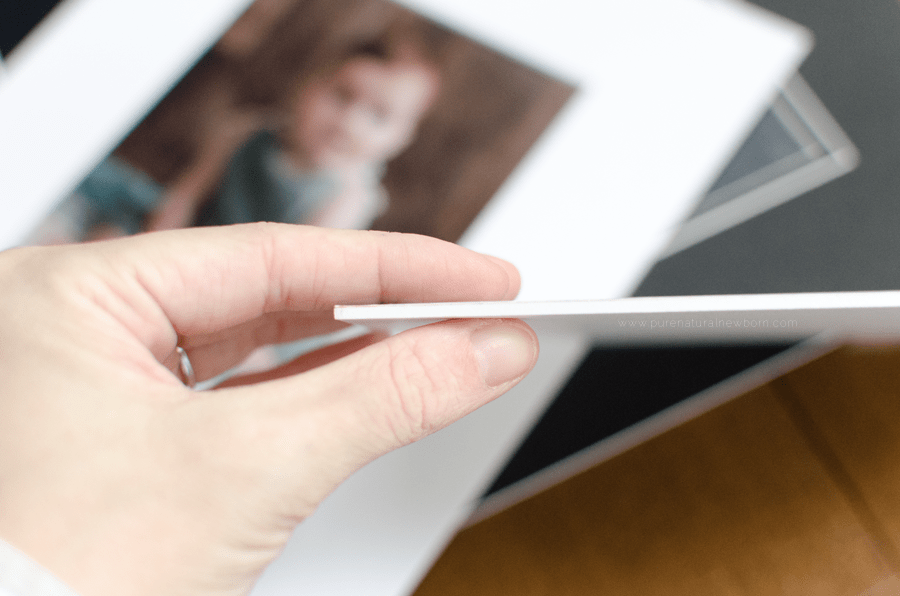
    Mounted prints are very similar visually to a regular paper print, but with an extra rigid backing meant to provide stability and protection. In short, the art print is mounted onto the substrate for ultimate protection against warping and damaged corners. These are absolutely great for displaying individually or in a group on an easel for the smaller sizes, as keepsakes in an archival image box, or for use in frames.

    Matted Prints

    Matted prints are likely more familiar to most, since they are commonly seen in framed pieces across the globe in family homes. The difference to those already in the frames, is that these prints come encased in the mat, rather than it just being a pretty topical piece for the frame. In other words, they are stand-alone pieces. They have the same quality art print placed in the ‘envelope’ of a beautiful mat (similar to a really thick cardstock, but with embellishments), meant to provide stability and protection warping and damage. These are also great for displaying individually in a beautiful frame, or as keepsakes in an archival image box.

    So which is better? Mounted or Matted Prints

    Now that you have all of the information, you can make and educated decision on which are best for YOU.

    They are both high quality print products, so it really comes down to how you plan on using them, where you intend on displaying them, and which ones you think are prettier or best fit the space. It really is that simple, and you can’t go wrong!

    Photographer’s Choice

    My personal choice is matted prints of my all-time favourites in the linen folio box, swapping them into frames as life goes on and I capture new photographs. The rest are printed in bulk on high quality photo-stock and stored in a sleeve made with special acid-free materials to preserve the prints, in an archival linen image box. I look forward to sharing them with my grandchildren, and it acts as my secondary backup system. And of course, I provide that same backup-system to all of my clients when they purchase their digital keepsakes.

  • Types of Printmaking: What’s the Difference?

    Types of Printmaking: What’s the Difference?

    Understanding Printmaking and Fine Art Prints

    Printmaking refers to a range of artistic techniques used to create images through a printing process. These printed artworks—known as prints—can appear quite similar at first glance, whether they’re engravings, etchings, lithographs, or screen prints. But look closer, and you’ll notice distinct differences in how each piece is made.

    If you’re considering purchasing a print, it’s helpful to understand the method behind it. Each printing technique has its own history, style, and finish. Here’s a quick guide to the six main types of fine art printmaking:

    • Relief printing (c. 1400s): like woodcuts, where the image is carved into a surface and inked.
    • Intaglio printing (c. 1500s): such as etching, where ink fills grooves cut into a plate.
    • Planographic printing (c. 1800s): lithographs are made by drawing with oil on a flat stone or plate.
    • Stencil printing (c. 1925): screen printing uses mesh to transfer ink onto paper or fabric.
    • Photographic printing (c. 1850s): includes methods like photogravure, using light-sensitive processes.
    • Digital printing (c. 1960s onward): such as giclée and laser prints, created with high-resolution digital technology.

    Modern printmaking offers artists and collectors a diverse, exciting world of possibilities—each with its own character and craftsmanship.

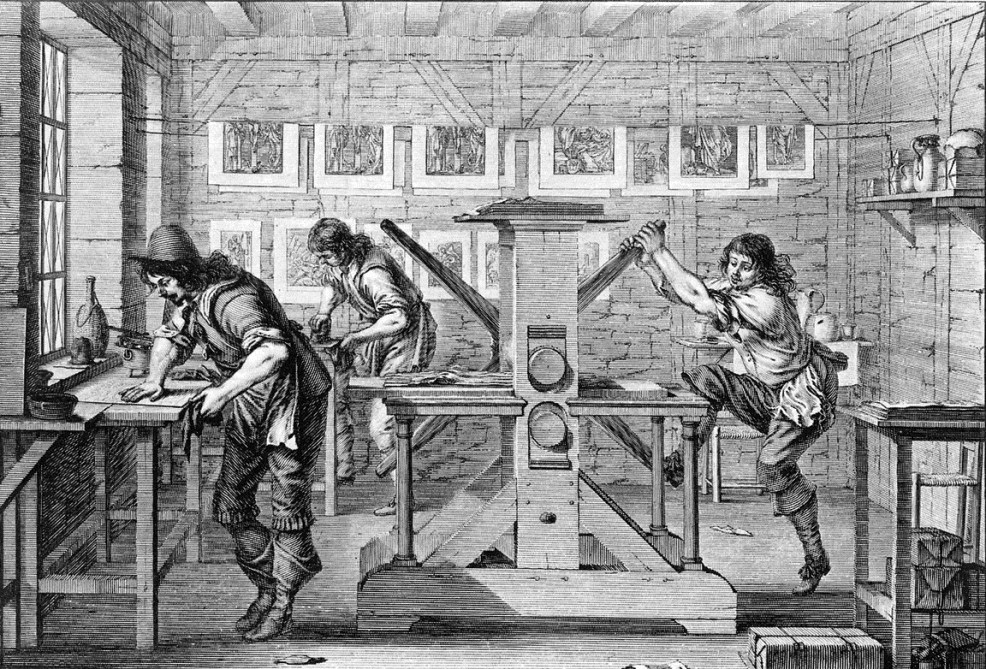
    Printing Techniques; 17th century printing (etching/engraving), A. Bosse (1645)

    In today’s art world, all six traditional printmaking techniques are still valued and widely used. Lithography and screen printing are the most popular right now, but etching is also making a comeback. Computer-based printing is used less for now, but that may change soon.

    It’s interesting to note that while many of these older methods have been replaced in commercial printing, they’re still very much alive in the art world. Each technique offers its own unique style and creative possibilities, which artists continue to explore.

    You might see an old printing press on display in a museum, while just down the street, the same type of press is being used by an artist in their studio.